.svg)



Welcome to Prove It, a new series spotlighting the latest AI-forward capabilities, integrations, and platform innovations helping organizations build and demonstrate cyber resilience in the AI era. Each edition highlights what's new in Immersive One, why it matters, and how it helps leaders move from assumptions to evidence as AI transforms the way people work, defend, and lead their organization.
"Real attackers don’t hand you their source code. Most internal labs fail the realism test before the first exercise begins. "
Rebecca: Enterprise AI adoption has completely outpaced red team readiness. New attack surfaces are appearing faster than most security organizations can assess them. Where are red teams actually getting stuck right now?
Nye: The instinct is right. Leaders know they need to train their people on AI offensive techniques. But the approach most are taking creates its own problems. Teams are trying to build vulnerable AI applications in-house. That’s a significant engineering drain.
Even when they pull it off, those internal setups rely on white-box access to source code. Real threat actors don’t have that luxury. You end up with testers who’ve practiced in a sterile environment and lack the muscle memory for actual black-box adversarial attacks.
Rebecca: So the gap is in operational readiness, not awareness. The last four AI Red Team collection releases drop testers straight into live sandbox environments with functional enterprise applications rather than simulated ones. Why does that distinction matter to a security manager?
Nye: Because it connects theory directly to execution. Your testers are interacting with fully operational autonomous agents and RAG pipelines, exploiting malicious MCP servers just as they would in the real world. That means managers get 1:1 verification of the exact MITRE ATLAS techniques their team is equipped to defeat. They don’t have to rely on assumptions.
Rebecca: That’s the proof CISOs are missing right now. It’s not just “we educated our team”. It’s “here’s exactly which AI attack techniques we know our team can execute and report on.” What does that change in terms of how security leaders report their capability up the chain?
Nye: It changes everything about that conversation. Right now, most red team reporting is activity-based. Hours logged, exercises completed, that sort of thing. This gives you technique-level evidence. You can tell the board which ATLAS vectors your team tested against in live environments, which ones exposed gaps, and what you’re doing about it. That’s a defensible security posture, not an activity log.
Introducing Two New AI Red Team Collections: Live, Framework-Backed, Operator-Ready
Stop assuming your red team can handle AI-native attack surfaces. Immersive One’s AI Red Teaming collections drop testers directly into functional sandbox environments so managers get verified, ATLAS-mapped evidence of what their team can actually execute.
Exploit AI Agent Vulnerabilities and RAG Ingestion Risks
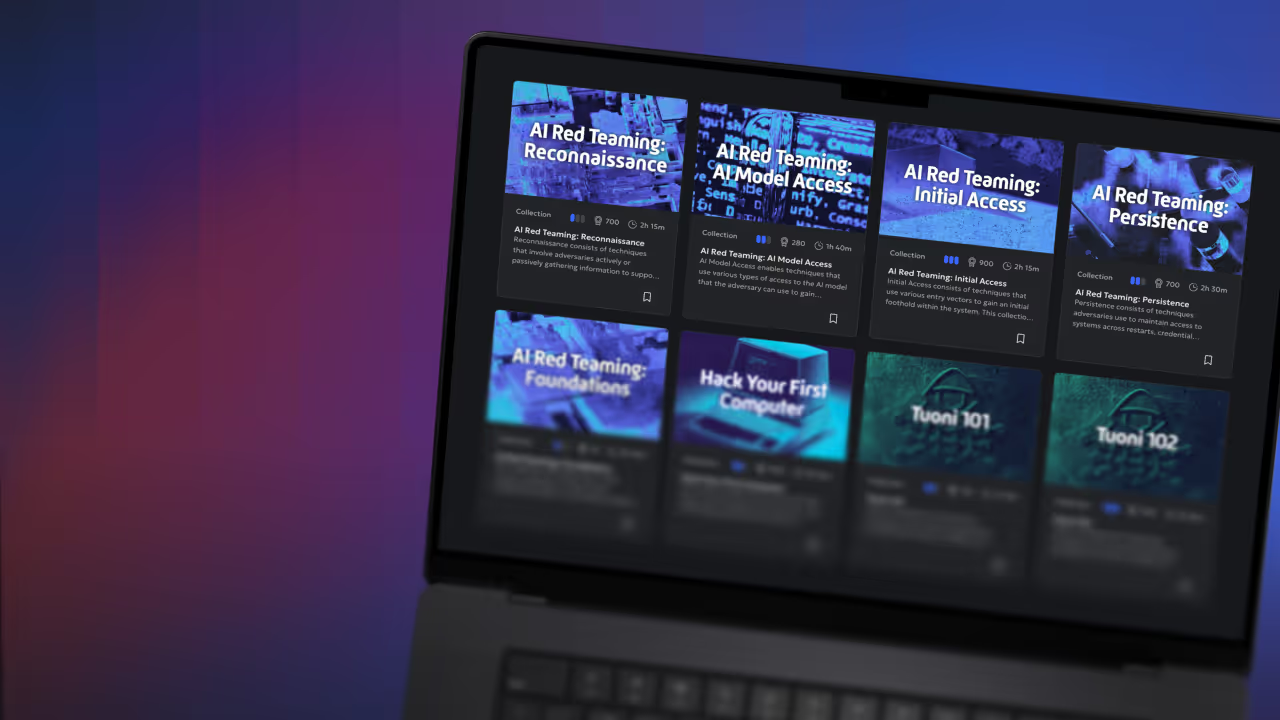
New AI Red Teaming: Persistence and AI Red Teaming: Initial Access collections put testers inside real enterprise AI architectures to execute and report on the exact techniques threat actors use today. With Immersive One, you can:
- Verify ATLAS-mapped technique coverage: Confirm which data-poisoning and persistence techniques your team can execute against live environments.
- Demonstrate real enterprise breach impact: Execute a single poisoned document exploit to achieve unauthorized internal API execution.
- Expose long-term persistence vectors: Analyze how Excessive Agency lets an attacker corrupt AI memory for undetected, sustained access.
Map the Shadow AI Attack Surface and Fingerprint Models
The AI Red Teaming: Reconnaissance and AI Red Teaming: Model Access collections equip red teamers to locate untracked deployments across the enterprise network and fingerprint underlying models using targeted prompts with no source code required, exactly as a real attacker would operate. With Immersive One, you can:
- Eliminate shadow AI blind spots: Surface rogue deployments running outside official security controls before they become active attack vectors your team wasn't prepared for.
- Cut engagement timelines: Use model-specific prompts to move past generic jailbreaks and pivot directly to high-success, targeted attacks against identified models.
- Harden AI infrastructure proactively: Pinpoint permission flaws, access configuration gaps, and identity governance vulnerabilities during active assessments.
Looking Ahead: Immersive One’s AI Offensive Roadmap
The work doesn't stop here. Upcoming collections will expand deeper into the MITRE ATLAS framework to cover Privilege Escalation, Lateral Movement, and Defense Evasion. That means red teams can test an AI environment breach from initial foothold to full system compromise. The goal is a complete, framework-backed picture of your AI attack surface, and verified evidence that your team can navigate it.
Get Started
Already on Immersive One? Log in and navigate to Artificial Intelligence or Offensive Security under the Upskill tab to find these labs.
Exploring Immersive One? Book a demo with the Immersive team to discover how to benchmark and prove your offensive team’s readiness against real-world AI threats.

See how to prove readiness with one platform.
See how Immersive One helps technical teams and leaders prove readiness, close capability gaps, benchmark progress, and report cyber resilience with confidence.